
Sound: sizing a PA for your audience
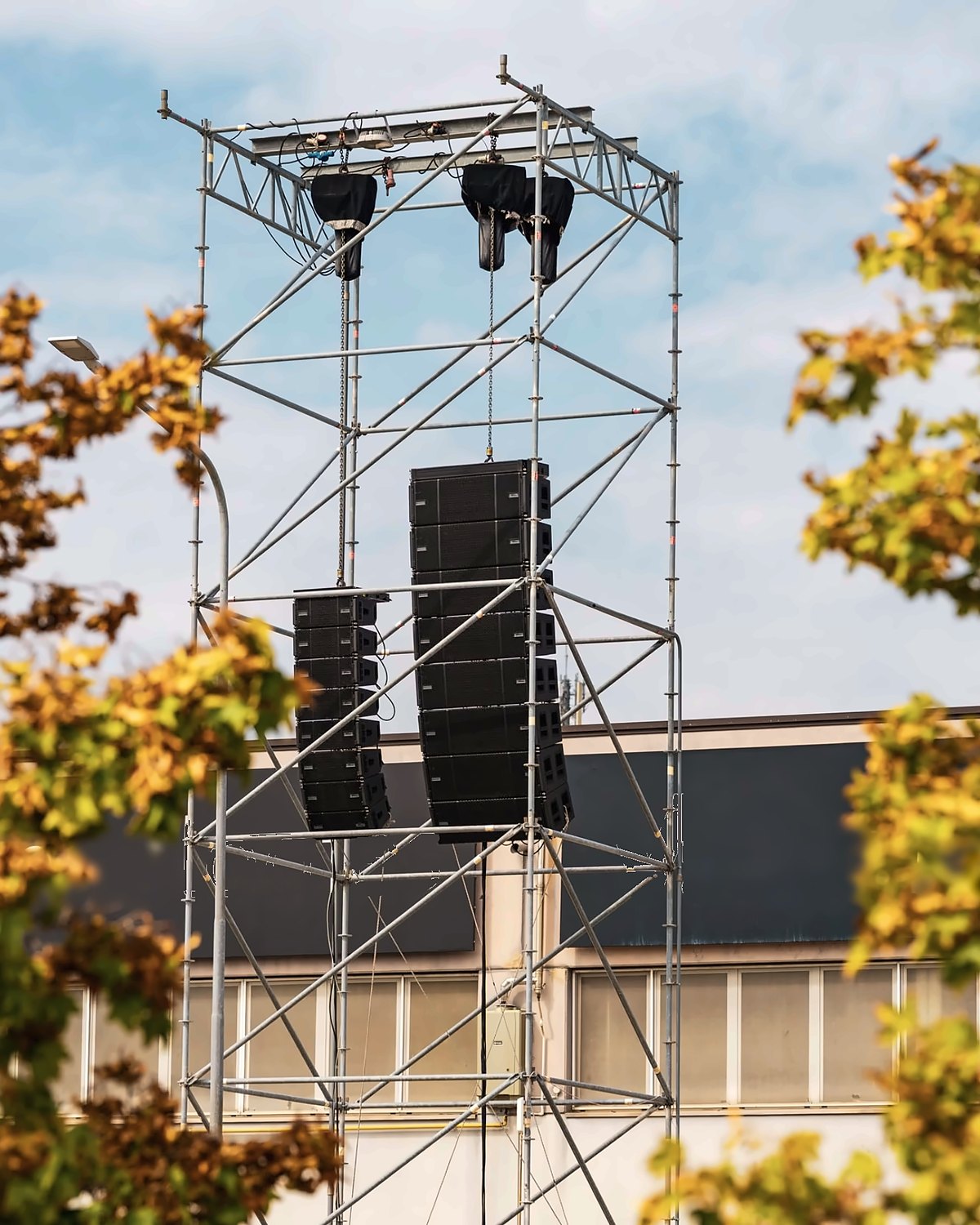
The main speakers have to reach the back row at a comfortable level without being painfully loud at the front. For up to about 120 people, a pair of compact speakers on stands usually covers the room. From a few hundred people, a short ground-stacked line source or larger point-source speakers work well. Past roughly 400 to 500 people, a flown line array becomes the right tool, because each box covers a different slice of the audience and the sound stays even from front to back.
Subwoofers carry the low end. Speech-only events need few or none; live bands and DJs need them, usually ground-stacked in front of the stage. Big rooms add front fills along the stage lip for the first rows, and delay speakers when the audience is deeper than about 40 meters.
Professional speakers from L-Acoustics and d&b audiotechnik run on their own amplified controllers, and the makers’ design software (Soundvision, ArrayCalc) sets the exact number of boxes, angles and amplifiers for each room.
Shop:SpeakersAmplifiers
Microphones and in-ear monitors: how many channels?
Plan one wireless channel for every person who talks or sings at the same time, plus at least one spare. Receivers like the Shure Axient Digital AD4Q and ULX-D ULXD4Q handle four channels each, so eight presenters plus a spare means three receivers. Past about eight channels, a spectrum manager coordinates frequencies and prevents dropouts.
Musicians who use in-ear monitors each need their own mix. In-ear transmitters carry two or four mixes each, and every performer needs a bodypack receiver. In-ears keep the stage quieter and the front-of-house mix cleaner; wedges are simpler and work well for speeches and small bands.
Shop:Wireless
Mixing consoles: matching channels to your show
Count your inputs. Speeches and playback rarely need more than 16 channels, which fits a compact digital console. A band uses about six inputs per musician (a drum kit alone takes eight to ten), so a five-piece band needs around 32 channels and a stage box to bring them to the console over one cable.
When a band uses in-ear monitors, larger shows add a second console just for monitor mixes, so the front-of-house engineer can focus on the audience.
Lighting a stage: spots, washes, beams and key light
Stage width sets the fixture count. A common starting point for a concert is about three spots or profiles and three washes for every four meters of stage, spread over two or three trusses, plus beams and strobes for energy. Corporate and wedding stages need fewer moving lights but more attention to front light.
Front (key) light from about 45 degrees on each side keeps faces even and natural, which matters most when cameras are rolling. A light haze makes beams visible; check the venue’s smoke-detector rules first.
About 60 fixtures or more is a big rig: a full-size lighting console with a processing unit keeps it responsive. Outdoors, choose IP65-rated fixtures that are sealed against rain and dust.
LED walls: size, pixel pitch and viewing distance
A screen should be tall enough for the farthest viewer: the image height should be at least one sixth of the distance to the back row. A 16:9 image that is 3 meters tall is about 5.3 meters wide.
Pixel pitch is the distance between pixels in millimeters. As a rule of thumb, the closest viewer should be at least as many meters away as the pitch in millimeters, and two to three times that for a comfortable image. Corporate rooms and broadcast sets with people close to the screen use fine pitches around 1.5 to 2.6 mm; concerts and festivals viewed from farther away use 3.9 to 8.3 mm panels, which are brighter and cost less per square meter.
Every LED wall needs a processor that scales the video and controls color and brightness, and large walls add fiber distribution.
Projection: brightness and throw ratio
In a room with controlled light, plan roughly 1,000 to 1,500 lumens for every square meter of image. A 6 by 3.4 meter image (about 20 square meters) calls for a projector in the 20,000 to 30,000 lumen range.
The lens sets where the projector can go. Throw ratio is the projector’s distance divided by the image width, so a 6-meter-wide image projected from 12 meters away needs a 2.0:1 lens.
Shop:Projection
Cameras and IMAG
IMAG (image magnification) puts close-ups of the stage on the screens so the back of the room can see faces. Two cameras cover most events up to about 1,500 people; larger shows use three or four. A camera more than about 40 meters from the stage needs a long box lens.
A live production switcher cuts between cameras, slides and graphics, and the same output can feed a livestream or recording.
Rigging and motors: the basics
Speakers, LED walls and lighting truss hang from chain hoists. As a starting point, plan two motors per speaker hang, about one motor for every 1.2 meters of LED wall width, and one motor every five to six meters of lighting truss. Heavy loads such as PA and LED use one-ton motors; lighter truss can use half-ton motors.
An eight-way motor controller runs eight hoists from one pendant. Indoors, everything hangs from the venue’s rated rigging points; outdoors, from the stage roof. Every rigging plan must be calculated and signed off by a qualified rigger.
Shop:MotorsAutomation